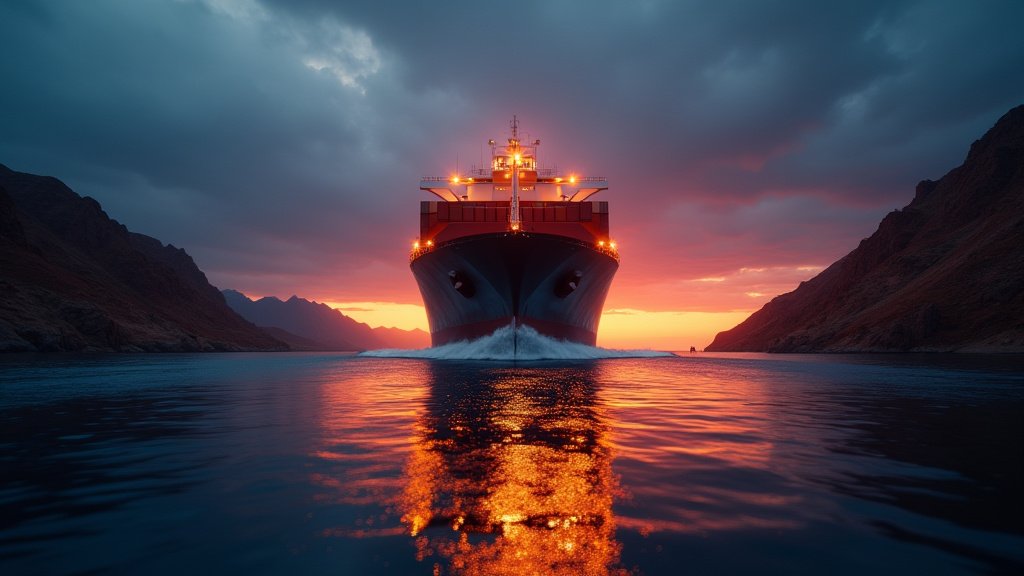
In a significant shift for global maritime trade, U.S. President Donald Trump announced that ships transiting the Strait of Hormuz will not face any transit fees following the expiration of a 60-day period stipulated in a U.S.-Iranian memorandum of understanding. This decision aims to facilitate smoother passage through the critical waterway.
Key Highlights:
- No transit fees will be imposed on ships using the Strait of Hormuz.
- The fee waiver follows a 60-day period outlined in a U.S.-Iranian memorandum.
- This move is expected to ease maritime traffic and reduce operational costs.
- The Strait of Hormuz remains a strategically vital chokepoint for global oil supply.
Navigating the Strait: A New Era for Maritime Transit
The announcement by President Trump marks a notable development in the complex geopolitical landscape surrounding the Strait of Hormuz. The directive to waive transit fees, effective after a predetermined 60-day period, signals a commitment to ensuring unimpeded passage through this vital maritime artery. The Strait of Hormuz, a narrow waterway connecting the Persian Gulf to the Gulf of Oman, is crucial for the global energy market, with a significant portion of the world’s oil supply passing through it daily. The U.S.-Iranian memorandum of understanding, though not fully detailed in public, appears to have set a temporary framework that will now transition into a fee-free transit regime under U.S. oversight. This policy shift is anticipated to reduce the financial burden on shipping companies and could potentially lead to lower shipping costs, impacting the broader global supply chain. The strategic importance of the Strait has often made it a point of tension, and this move appears to be an effort to de-escalate potential friction and promote stability in the region’s maritime operations.
Economic Ramifications of Fee-Free Transit
The economic implications of this decision are far-reaching. For commercial shipping lines, the elimination of transit fees directly translates to reduced operational expenditures. This saving can be particularly impactful for vessels carrying bulk cargo, including oil tankers, which frequently navigate the Strait. Analysts suggest that these cost reductions may eventually be passed on to consumers in the form of lower fuel prices or reduced costs for goods transported via maritime routes that depend on this passage. However, the long-term economic benefits will also depend on sustained stability in the region and the absence of any geopolitical disruptions that could otherwise impact shipping and trade.
Geopolitical Context and Regional Stability
The Strait of Hormuz has long been a focal point of geopolitical tensions, given its strategic location and the volume of global trade that relies on it. The U.S.-Iranian memorandum, and now this fee-waiver policy, can be viewed within the broader context of regional diplomacy and security. By removing potential financial barriers, the U.S. administration appears to be aiming to foster a more predictable and secure environment for international shipping. This approach could also be interpreted as an attempt to maintain U.S. influence over critical global chokepoints while simultaneously signaling a move towards de-escalation of direct confrontation. The effectiveness of this policy in ensuring long-term regional stability will be closely watched by international observers and maritime stakeholders.
Implications for Global Energy Markets
As a critical transit point for a substantial percentage of the world’s seaborne oil trade, any policy affecting the Strait of Hormuz has immediate implications for global energy markets. The announcement of fee-free transit is likely to be viewed positively by oil-producing nations in the Gulf and by consuming nations worldwide. It reduces a potential cost factor that could otherwise contribute to price volatility. Ensuring the free and secure flow of oil through the Strait is paramount to global energy security, and this policy appears designed to reinforce that objective. The stability of oil prices and supply chains will be influenced by the consistent implementation of this fee-waiver policy and the broader geopolitical climate.
FAQ: People Also Ask
What is the Strait of Hormuz?
The Strait of Hormuz is a narrow strait that lies between the Persian Gulf and the Gulf of Oman. It is one of the world’s most important oil transit points, serving as a chokepoint for approximately 30% of the world’s seaborne oil trade.
What was the U.S.-Iranian memorandum of understanding?
While specific details are not widely publicized, the memorandum of understanding likely established a temporary framework or agreement between the United States and Iran regarding the passage of ships through the Strait of Hormuz, possibly including provisions related to fees or security protocols. The 60-day period mentioned refers to a phase within this agreement.
How will waiving transit fees affect shipping costs?
Waiving transit fees is expected to reduce operational costs for shipping companies, potentially leading to lower overall shipping expenses. These savings could, in turn, result in reduced prices for goods and fuel, benefiting consumers.
Why is the Strait of Hormuz strategically important?
Its strategic importance stems from its role as a critical chokepoint for global oil transportation. Control or disruption of the Strait could significantly impact the global economy by affecting oil supply and prices.
What are the potential economic benefits of fee-free passage?
Beyond reduced shipping costs, fee-free passage could encourage increased trade volume and enhance the reliability of supply chains that depend on this route, contributing to global economic stability.